Response to Melanie Cove, Kettle’s Yard, 28.01.2026
‘I know the weight of you,’ the artist repeats, murmuring through speakers as her collaborator, Tonantzin Borrego folds her body into the shape of a heavy beloved subject. The pair make their way up a staircase, backwards.
The audience listens to a series of memories, recollections of a life lived alongside a brother with brittle bones. As they reach the top of the staircase I hold my breath suddenly aware of the vertigo of carrying a fragile relative balancing in a wheelchair, and the consequences of slipping.
At the foot of the stair, two assistants stop the flow of the audience through the performance. The role is functional and conceptual: they wear custom fluorescent jackets, the backs of which read: “it was illegal / to travel on the / London Underground / in a wheelchair / until 1993.’
Wheelchair users were labelled ‘fire hazards’.
In the 1990s, the Campaign for Accessible Transport used direct action methods to shift these ableist norms, handcuffing themselves to buses or using their chairs to block traffic in Oxford Street. The ‘We Will Ride’ campaign demanded that new buses had to be accessible In 1995, the Disability Discrimination Act recognised their struggle.
Nowadays wheelchair users are technically allowed on all public transport, but in practice endless obstacles prevent equal access – lifts constantly out of order, assistance ramps not always available.
Melanie Cove’s performance speaks into the continued gap between how enabled and disabled bodies exist in public space. In the process, she reflects on the mechanics of care work, often physical and inconvenient, which accompanies the effort of helping someone exist in a built environment which has been constructed so as to prevent access.
The artist invited me to respond to this work back in January, a generous offer of dialogue which I took up before swiftly becoming overwhelmed by the need to give space to my own disabling condition, albeit mental not physical. I pushed my deadline so that I could nap and cook for myself and planned to write this piece at the end of March. When that date came, it turned out I was in Paris, looking after my fiancée while she recovered from gender affirming surgery – a long-awaited operation which was arranged late notice. I figured she would be asleep and resting much of the day and I could write then. But I was busy caring for her – bringing her croissants, organising her medication, cleaning the flat, cooking pasta, walking across Paris on a Sunday to buy sleeping pills, staying alert to her movements so that I could be ready to take small daring walks around the block and then, as she recovered faster than we had hoped, walks into Corbevoie where we sat people-watching and drinking coffee. And when I wasn’t doing that, I was exhausted too, so happy to crash in front of Emily in Paris (which we watched with French subtitles, on our short-term landlord’s Neflix account). All of these tasks were so absorbing and so meaningful that I let the deadline slip without noticing. And that was the effect of being a carer for a few days – really, hardly anything.
The artist’s performance draws attention to the space which long-term care work expands into over a lifetime: ‘I know the weight of you’.
The artist’s brother, Ben Cove, the silent addressee of the text, passed away in 2016. This performance is a memorial, addressing the absence of a beloved relative. Simultaneously, the artist grieves the cessation of the activity of caring for him: the difficult, frustrating, privileged act of carrying someone else’s needs in your arms.
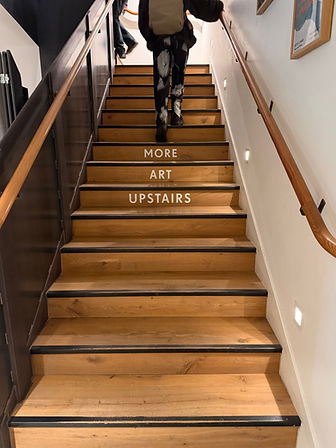
The stairs at Kettles Yard, Cambridge
